 News & Updates
Why Load Bank Testing Is Critical for Data Center Reliability
As data centers scale to meet the unprecedented demands of artificial intelligence, cloud computing, and edge infrastructure, the importance of rigorous power system commissioning has never been greater. Every minute of downtime translates to significant financial losses, reputational damage, and potential safety risks. Load bank testing provides the controlled, repeatable validation that ensures backup power systems will perform when it matters most.
The Stakes Are Higher Than Ever
Modern data centers are among the most power-dense facilities ever constructed. A typical hyperscale data center can consume 20–50 megawatts of power — equivalent to a small town. Within this infrastructure, every generator, every UPS module, and every distribution pathway must be validated before the facility goes live.
"Load bank testing isn't just a checkbox — it's the last line of defense before your facility goes live. We've seen generators pass all factory tests yet fail on-site within the first six months because commissioning was skipped."
What Load Bank Testing Validates
Load bank commissioning goes far beyond simply verifying that a generator starts. A comprehensive load test validates:
- Full-load capacity: The generator's ability to carry its rated load continuously without overheating or derating
- Voltage and frequency stability: Steady output under varying load conditions, simulating real-world demand fluctuations
- Fuel system performance: Consumption rates, fuel pressure, and supply chain readiness for extended operation
- Cooling system adequacy: Radiator, fan, and coolant system performance under sustained thermal load
- Control system response: Automatic start/stop, load sharing in multi-unit systems, and transfer switch coordination
- Harmonic analysis: Power quality at load to ensure compatibility with sensitive IT equipment
Resistive vs. RL Combined for Data Centers
Data center testing primarily uses resistive load banks because the critical IT load is predominantly resistive in nature (power supplies, lighting, cooling system motors — with UPS systems acting as reactive buffers). However, for generator testing that includes the full facility load — including HVAC, elevators, and other inductive loads — an RL combined load bank provides a more accurate simulation of real-world conditions.
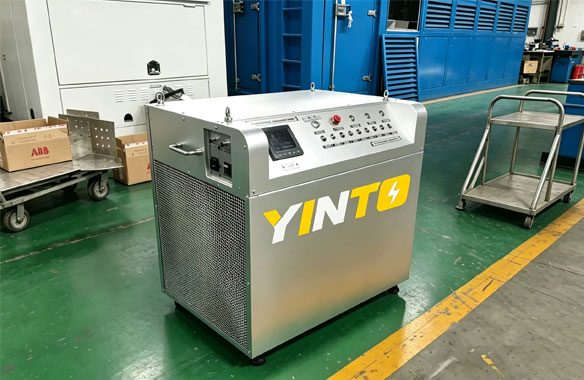
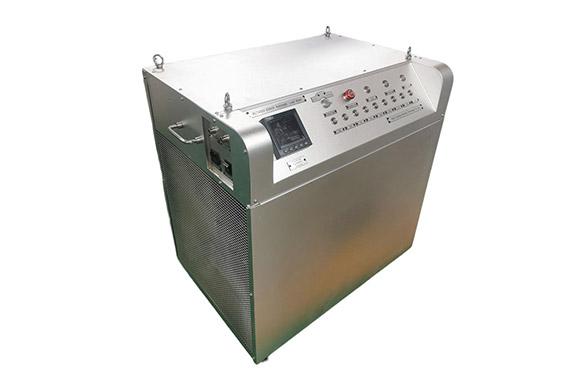
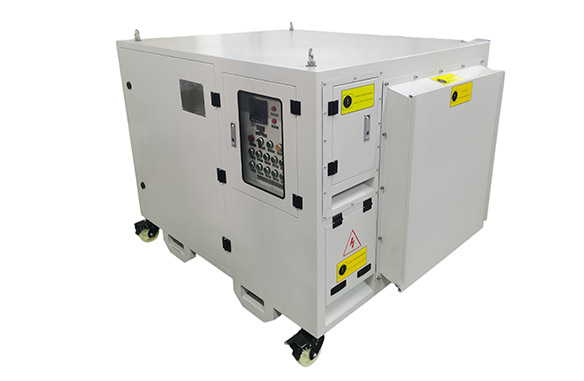
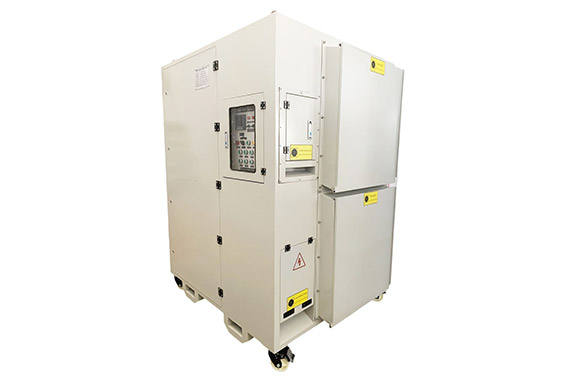
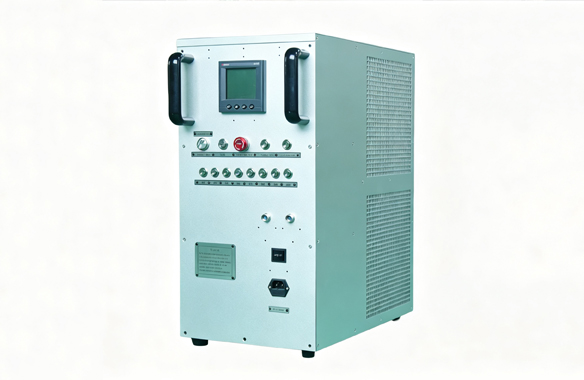
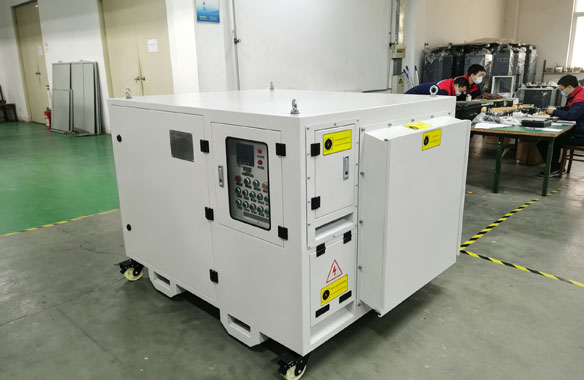
YINTO's resistive load bank range (from 100kW suitcase units to 1000kW high-power systems) covers the full spectrum of data center commissioning requirements, from single-module testing to megawatt-scale facility validation.
Best Practices for Data Center Load Testing
1. Test at 100% of Rated Capacity
Testing at 70–80% of rated capacity is common practice but misses critical failure modes that only manifest at full load. At 100% load, you identify thermal limitations, governor response issues, and fuel system weaknesses that lower-load testing simply cannot reveal.
2. Run Extended Duration Tests
A 2-hour test is better than a 30-minute test. A 4–8 hour continuous run is the gold standard for critical facilities. Many problems — fuel vaporization, cooling degradation, bearing wear — only become apparent over extended operation.
3. Document Everything
Every test should generate a formal report with: date, ambient conditions, load levels, voltage/current readings, fuel consumption, temperature readings, and any anomalies observed. YINTO's PC software automates this data collection and report generation.
4. Test the Whole System
Commission the entire chain: utility input → ATS (Automatic Transfer Switch) → generator → distribution → UPS → critical load. Many failures occur at the interfaces between these systems, not within any individual component.
The Cost of Skipping Load Bank Testing
Industry data consistently shows that facilities without formal load bank commissioning face significantly higher rates of backup power failure during actual outages. A 2019 survey by the Uptime Institute found that 35% of data center outages involved standby power systems — and a significant portion of those were in facilities that had skipped or abbreviated commissioning testing.
The cost of a single data center outage can range from $100,000 to over $5 million depending on scale and duration. Load bank testing costs a fraction of this — typically 0.5–2% of the total infrastructure cost — yet it is the single most effective investment in backup power reliability.
YINTO's Data Center Testing Solutions
YINTO has supplied load bank testing solutions to data center projects across 50+ countries. Our range includes:
- LBS100: Portable suitcase unit for single-module UPS and generator testing — ideal for edge data centers and modular facilities
- LBP200/300: Portable load banks for medium-scale data center commissioning
- LBP500–1000: High-power systems for hyperscale facility validation
- LBRL Combined: For generator power factor testing and full-facility load simulation
Our engineering team provides turnkey commissioning support — from test planning and load calculation to on-site execution and report delivery. Contact us to discuss your data center testing requirements.